
Node-positive, ER+/ HER2- early-stage breast cancer with HIGH risk of recurrence

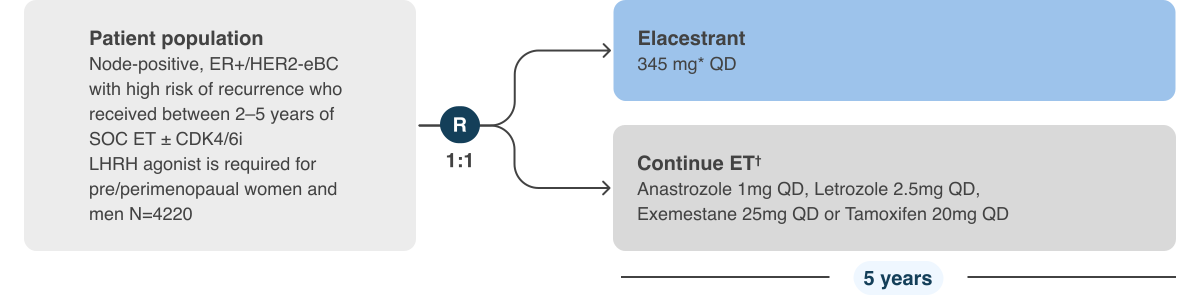
ELEGANT is a phase 3, randomized, open-label study comparing elacestrant with standard-of-care endocrine therapy (SOC) ET in women and men with node-positive, estrogen receptor-positive (ER+), human epidermal growth factor receptor 2-negative (HER2-), node positive early-stage breast cancer (eBC) with a high risk of recurrence.

About the ELEGANT Study 

Patients with node positive ER+/HER2- eBC continue to be at risk of local and distant recurrence. As a result, new therapies with improved long-term efficacy and desirable safety profiles are warranted.

The ELEGANT Study (NCT06492616) will evaluate the efficacy and safety of elacestrant, an oral selective estrogen receptor degrader, relative to SOC ET to see if elacestrant can improve invasive breast cancer-free survival (IBCFS) in patients with node positive ER+/HER2- eBC with high risk of recurrence.

The ELEGANT Study is also investigating if elacestrant may:

Reduce the chance of recurrence

in people living with node positive ER+/
HER2– early-stage breast cancer with high risk of recurrence

Benefit patients earlier in the treatment course

through estrogen-receptor degrading activity 

Lower treatment burden for patients

with a once daily oral regimen 

The ELEGANT Study rationale

Elacestrant is an orally active selective ER degrader and antagonist. Elacestrant exhibits selective degradative activity in breast and uterine tissues and agonist activity in bone.


Unlike currently available adjuvant ET, including aromatase inhibitors (AI) and tamoxifen, elacestrant may1:


  • Reduce ER availability through selective estrogen degradation (SERD), showing reduction in tumors regardless of ESR1 mutation status2
  • Protect against bone loss and reduce hot flashes through partial agonist (SERM) activity1,3,4,5


In ER+/HER2- eBC patients, preoperative phase 2 trials
SOLTI-1905-ELIPSE6 and SOLTI-2014-PremiERe7 showed that elacestrant is associated with a statistically significant mean change of complete cell cycle arrest rate and led to a shift in tumor biology towards a more endocrine-sensitive and less proliferative phenotype in both pre- and post-menopausal women.

The ELEGANT Study design

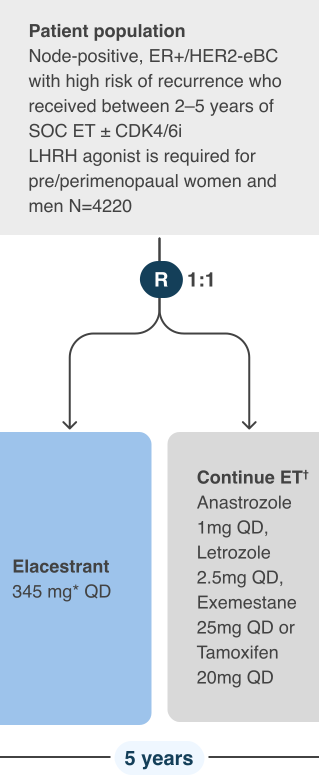
A total of 4,220 participants will be randomized from approximately 500 study centers across North America,
South America, Europe, and Asia. These participants will be randomly sorted into two groups: one that
receives elacestrant and one that receives the SOC ET.

  • Menopausal status (pre/perimenopausal vs. postmenopausal)
  • Prior CDK4/6i treatment in the adjuvant setting (yes vs. no)
  • Time since curative surgery (≤ 4 years vs. >4 years)

For more detailed information
about the study design, download the study design overview.  

Eligibility criteria for the ELEGANT Study

In order for patients to participate in the ELEGANT Study, they must meet the following key criteria:  

The ELEGANT Study is open to people of all gender identities, ethnicities, and racial backgrounds. By including a diverse population in
our study, we may determine whether future treatments being developed could be safe and work for as many people with breast cancer
as possible.

Confirmed ER+ (≥10% by IHC) and HER2- (IHC=0 or 1, or IHC=2 and ISH-negative) early stage resected invasive breast cancer
without evidence of recurrence* or distant metastases, per local laboratory, according
to ASCO/CAP guidelines.
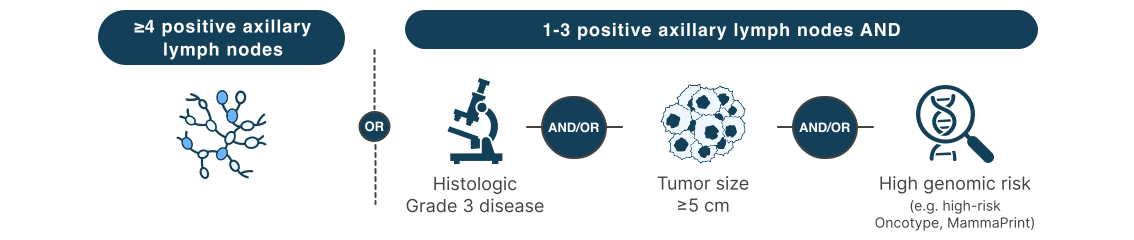
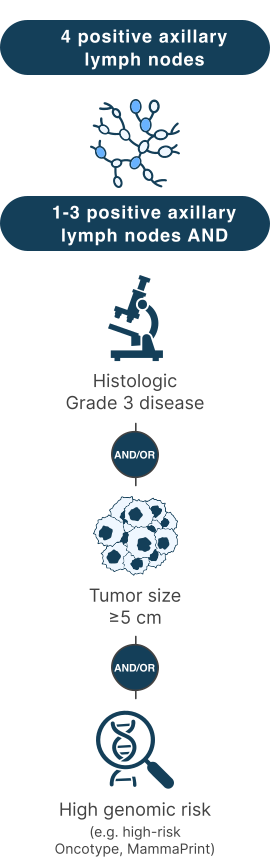
Early-stage invasive breast cancer at high risk of recurrence

Patient is 2–6 years from the date of curative surgical resection and has received at least 2 but not more than 5 years of ET (Ais
or tamoxifen) ± CDK4/6i

For a complete list of study inclusion and exclusion criteria, download the ELEGANT Study eligibility card.  

Share the ELEGANT Study with a patient

If you are treating or know of a patient who may be a suitable candidate for the ELEGANT Study, connect them with a location or download a patient brochure with more information.

References

  1. Wardell SE, et al. Endocr Relat Cancer. 2015;22:713-724.
  2. Bardia A, et al. J Clin Oncol.
    2021;39(12):1360-1370.
  3. Garner F, et al. Anticancer Drugs. 2015; 26(9):948-956.  
  4. McDonnell DP, et al. J Clin Oncol. 2021; 39(12):1383-1388.  
  5. Mechanism-based discovery of SERMs and SERDs. Duke University School of Medicine. Accessed November 20 2025. https://
    sites.duke.edu/mcdonnelllab/mechanism-based-discovery-of-serms-and-serds/
    .
  6. Clin Cancer Res 2025;31:1223–32.
  7. Clin Cancer Res 15 February 2026; 32 (4_Supplement): PD10–01.